Botemkin

the communist bot

Follow

Thursday, 25 October 2018


The Prohibition of Solicitation of Prostitution Services Bill passed its first reading in the Knesset plenum on Monday, October 22, by a vote of 39-0. Under the terms of the bill, first-time offending Johns would be fined NIS 1,500, with the penalty increasing to NIS 3,000 for those who repeat the offense within three years. Courts would be empowered to raise the fines to a maximum of NIS 75,300.

Demonstrators in Tel Aviv call to outlaw the solicitation of prostitution, August 20, 2018.

Demonstrators in Tel Aviv call to outlaw the solicitation of prostitution, August 20, 2018. (Photo: Task Force against Human Trafficking)

The explanatory notes accompanying the bill state, “Over the past few years, there is a growing recognition in Israel that the prostitution embodies very hurtful characteristics and that it must be diminished through rehabilitation, informing the public, education and enforcement.”

During the debate held prior to the vote, MK Michal Rozin (Meretz) said, “What we are doing here today proves that society can be changed and that things can be corrected. Prostitution is the tip of gender inequality, and this should cease to exist. Working in prostitution is not a free choice. While the bill does not include criminal sanctions, it does convey an important message to the public.”

Hadash MK Aida Touma-Sliman (Joint List), the head of the Committee on the Status of Women and Gender Equality said, “For me this issue was theoretical until that tour of the prostitution scene, which shook me to my core. I suggest that all members of Knesset go and see with their own eyes the exploitation and the sense of dignity being taken away. We
are at a critical time in history, the beginning of a revolution in this issue. The struggle is starting to come to fruition.”

The bill will now be transferred to the Constitution, Law and Justice Committee, which will prepare it for its second and third readings.


Data

Title: Bill Prohibiting Solicitation of Prostitution Passes First Reading
Link: http://maki.org.il/en/?p=16584
Source: Communist Party of Israel
Organization: CPI
Date: October 25, 2018 at 06:00AM

Actions

Translate original to: En | Es | Fr | De | Pt | Gr | Ca | +
Share original with: Twitter | Facebook | Google +

Labels: , ,

More information


Wednesday, 24 October 2018


A ministerial committee of Israel’s parliament voted on Sunday, October 21, to advance a bill that would cut subsidies to cultural institutions accused of not showing “loyalty” to the state, the culture minister announced. The proposed legislation, denounced by artists and freedom of speech activists, was proposed by far-right Culture Minister Miri Regev and supported by Neo-Liberal Finance Minister Moshe Kahlon.

The decision by the Ministerial Committee for Legislation means that the bill will be fast-tracked to a full cabinet vote before being introduced in the Knesset as a government-backed bill. It would give the finance and culture ministries the power to slash subsidies to any institution presenting work that denies, “Israel’s existence as a democratic and Jewish state or that marks the state’s independence day as a national day of mourning.”

Footage from the film prize winning Israeli film Foxtrot which Culture Minister Miri Regev severely criticized last year

Footage from the film prize winning Israeli film Foxtrot which Culture Minister Miri Regev severely criticized last year

According to the current proposal, the culture minister would be the governmental official empowered to determine whether any given cultural project should be disqualified for funding on the grounds of disloyalty. Attorney General Avichai Mandelblit gave his approval for Sunday’s cabinet decision to advance the legislation, on condition that it be revised to avoid posing “a serious risk to freedom of speech.”

Hadash MK Dov Khenin (Joint List) attacked the bill saying that the “demand for loyalty in art is another step in silencing expression and forcing culture to be a mouthpiece for the government.” Khenin added that “Regev is working not for the promotion of culture, but for the suppression of freedom of creativity and free thought.”

On Monday, October 22, dozens of cultural figures and intellectuals published a manifesto calling for the defeat of the bill. Among the signatories were author David Grossman, actor Liora Rivlin, poet Tuvia Ribner, choreographer Yasmeen Godder, sculptor Dani Karavan and many others. The text of the manifesto reads: “This bill must not be approved, we must not allow any government to use public funds to prevent the legitimate presence in the public space of varied opinions and views, which are not comfortable for the government, and it makes no difference which government we’re talking about.”

According to the Association for Civil Rights in Israel (ACRI), “The cabinet has abandoned the Israeli cultural world and put it in the hands of a minister. Since the culture minister assumed her position in May 2015, she has been working tirelessly to undermine artistic freedom of expression and to deter cultural institutions from dealing with controversial issues. The present government is afraid of any type of criticism of its policy, particularly criticism of the occupation, and is trying to silence any voice that does not express unreserved support for its worldview. That’s not how a democracy is conducted.”

Regev, a member of Israel’s ruling right-wing Likud party, is no stranger to controversy and has repeatedly clashed with the country’s largely left-leaning cultural spheres. Last year she slammed the Israeli drama Foxtrot, which won the Venice Film Festival’s second-highest prize for, in Regev’s opinion, spreading untruths about the Israeli army. She was not invited to September’s Ophir Awards – Israel’s version of the Oscars – where Foxtrot won the best picture prize. She instead appeared live on her Facebook page to criticize the movie and members of Israel’s Film and Television Academy.


Data

Title: Knesset Ministerial Committee Fast-Tracks “Culture Loyalty Bill”
Link: http://maki.org.il/en/?p=16567
Source: Communist Party of Israel
Organization: CPI
Date: October 24, 2018 at 06:00AM

Actions

Translate original to: En | Es | Fr | De | Pt | Gr | Ca | +
Share original with: Twitter | Facebook | Google +

Labels: , ,

More information


Tuesday, 23 October 2018


The unions of junior academic staff at public colleges announced a strike on Sunday morning, October 21, in an effort to improve their members’ employment conditions. The colleges on strike include Sapir College, Kinneret College, Ruppin Academic Center, the Kibbutzim College, the Holon Institute of Technology, Achva Academic College, the Tel Hai Academic College and the Ashkelon Academic College.

Members of striking junior academic staff of Tel Aviv University demonstrate on the school’s campus last Wednesday, October 17.

Members of striking junior academic staff of Tel Aviv University demonstrate on the school’s campus last Wednesday, October 17. (Photo: Junior Staff Union)

The junior staffs at Ben-Gurion University of the Negev and Tel Aviv University began open-ended strikes on Sunday, October 14, over pay and working conditions

Junior teaching staff in the universities are demanding better job security including an early notification regarding their employment for the following year, along with wages and sick days comparable to those holding similar positions in other higher education institutes. Disgruntled staff at Tel Aviv University held demonstrations in front of the university’s administration building and outside the front gates to raise awareness of their campaign.

In addition, the union of the junior teaching staff at the Technion, Israel Institute of Technology in Haifa, also declared a work dispute on Sunday, October 21, in anticipation their too going out on strike.

Related: Strikes by Junior Staff Cast Shadow Over Start of New Academic Year


Data

Title: Junior Academic Staff at Eight Public Colleges Got Out on Strike
Link: http://maki.org.il/en/?p=16559
Source: Communist Party of Israel
Organization: CPI
Date: October 23, 2018 at 06:00AM

Actions

Translate original to: En | Es | Fr | De | Pt | Gr | Ca | +
Share original with: Twitter | Facebook | Google +

Labels: , ,

More information


Monday, 22 October 2018


The forced evacuation of the Bedouin village of Khan al-Ahmar in the occupied Palestinian West Bank will be delayed until further notice, Israel announced on Saturday night, October 20. Far-right Defense Minister Avigdor Lieberman slammed the security cabinet’s decision and emphasized it was made “despite strong objections.” Security forces have said in recent days that they are ready to evacuate the village and are waiting for instructions to do so.

Three people were arrested in Khan al-Ahmar on October 15, after occupation forces arrived at the village to escort bulldozers preparing the infrastructures for the upcoming demolition of the village.

Three people were arrested in Khan al-Ahmar on October 15, after occupation forces arrived at the village to escort bulldozers preparing the infrastructures for the upcoming demolition of the village. (Photo: Activestills)

Regavim, a pro-settler Israeli NGO that had initially pushed the plan for displacement of the Bedouin, issued a statement lamenting the decision and calling it capitulation to the Palestinian Authority. Walid Assaf, head of the Palestinian National Committee to Resist the Wall and Settlements, speaking at a news conference held in the protest tent at Khan al-Ahmar said: “We don’t trust the Israeli decision to freeze the demolition of Khan al-Ahmar and we will continue our protests to protect the area.”

The residents of Khan Al-Ahmar are from the Arab-Bedouin Jahalin tribe expelled from the Negev during the 1948 war. The Jahalin then settled on the eastern slopes of Jerusalem. The Khan al-Ahmar community consists of about 35 families whose makeshift homes and schools, mostly constructed from corrugated metal and wood, have been demolished by the Israeli army several times in past years. Early in September Israel’s High Court of Justice rejected an appeal against the demolition of the village.

The Israeli human rights group B’Tselem said in a statement after the court ruling “Palestinians cannot build legally and are excluded from the decision-making mechanisms that determine how their lives will look. The planning systems are intended solely for the benefit of the [Israeli] settlers. This ruling shows once again that those under occupation cannot seek justice in the occupier’s courts.”

Israel announced in July that it plans to relocate the 180 residents of Khan al-Ahmar to an area about 12km away, near the Palestinian village of Abu Dis. However, the new site is adjacent to a landfill, and rights advocates say that a forcible transfer of the residents would violate international law applying to occupied territories.

Israeli Police Detain Palestinian Governor of Jerusalem

On Saturday, October 20, special units of the Israeli police detained the Palestinian governor of Jerusalem, Adnan Ghaith, in the town of Beit Hanina north of occupied east Jerusalem.

Informed sources told the Palestinian news agency Wafa that at least three police cars intercepted the car carrying the governor before seizing him and leading him to an unknown destination. No reason was given for the arrest. Earlier Saturday, the Israeli army detained Colonel Jihad Faqeeh, 50, who heads the Jerusalem office of the Palestinian Intelligence forces at a military checkpoint near the town of Qatannah, northwest of Jerusalem, as he was heading to work in Ramallah.

In addition, Israeli police forces detained a Palestinian youth, on Saturday, in Jerusalem for wearing a shirt of the Palestinian flag. Witnesses told Palestinian news agency Ma’an that Israeli forces prevented a Palestinian youth, entering the Al-Aqsa Mosque reportedly for wearing a shirt of the Palestinian flag. Israeli police forces stopped, searched and detained the youth from inside the Old City of Jerusalem and transferred him to an Israeli police station located on Salah al-Din Street, north of the Old City walls.

Related:


Data

Title: Israel Postpones Demolition of Khan al-Ahmar; Police Detain Palestinian Governor of Jerusalem
Link: http://maki.org.il/en/?p=16551
Source: Communist Party of Israel
Organization: CPI
Date: October 22, 2018 at 06:00AM

Actions

Translate original to: En | Es | Fr | De | Pt | Gr | Ca | +
Share original with: Twitter | Facebook | Google +

Labels: , ,

More information


Sunday, 21 October 2018


Racist election posters put up by the far-right religious HaBayit HaYehudi (Jewish Home) party in Ramla, a mixed Jewish-Arab city in the center of the country, were removed on Wednesday, October 16, after most of them were vandalized.

Only a handful of the 40 advertisements that went up around town the day before remained intact, Zion Cohen, director of the Zohar Outdoor Advertising Company, told Haaretz.

The removed posters encouraged Jewish residents to come out and vote in the upcoming October 30 municipal elections and strengthen HaBayit HaYehudi in the city government, lest they risk having their daughters marry Muslims.

The racist election advertisement posted by the far-right religious party HaBayit HaYehudi (The Jewish Home) in Ramla: “Tomorrow this could be your daughter… Only a strong HaBayit HaYehudi will safeguard Jewish Ramla.”

The racist election advertisement posted by the far-right religious party HaBayit HaYehudi (The Jewish Home) in Ramla: “Tomorrow this could be your daughter… Only a strong HaBayit HaYehudi will safeguard Jewish Ramla.” (Photo: Sikkuy)

Above a photograph of a woman wearing a hijab the posters bore the slogan “Tomorrow it could be your daughter,” Beneath the photograph the poster reads: “Only a strong HaBayit HaYehudi [in the municipal council] will safeguard Jewish Ramla.”

Renowned political illustrator Ze’ev Engelmayer came out costumed as his cartoon character Shoshke and covered the signs with his own posters titled “The daughters of Ramla.” Engelmayer told how “When I was going around I saw posters that had been vandalized… This generated real anger among residents. I am not harming the signs but it would behoove the advertising companies to know that racist ads that fan hatred create an effect that comes back like a boomerang and harms them as well. They shouldn’t cooperate with this.”

Sapir Slutzky Amran, a resident of Tel Aviv’s Hatikva neighborhood, hung her own protest posters over the HaBayit HaYehudi ones; hers bore the face of Naftali Bennett, HaBayit HaYehud’s chairman, and read, “Tomorrow this could be your son.” In a Facebook post, she wrote, “HaBayit HaYehudi decided to warn the fathers of the Jewish daughters of Ramla against assimilation, God forbid, but we decided to explain the dangers of racism to Ramla residents.”

Hadash MK Yousef Jabareen (Joint List) sent a letter to Attorney General Avichai Mendelblit on Wednesday demanding that parties spreading racist messages be prosecuted or even disqualified from running in the end of the month elections.

“There is no need to elaborate on the severity of this phenomenon and the serious damage it causes to the delicate fabric of relations between Jews and Arabs in general, and in the mixed cities in particular. Such racist and inflammatory messages are invalid and illegal and require immediate and decisive intervention by the attorney general to block their continued dissemination,” he wrote, referring to both the Ramla ads and others posted by the Likud two weeks ago in Tel Aviv proclaiming, “It’s us or them.”


Data

Title: Ramla: Racist Election Campaign Ads Removed after Vandalization
Link: http://maki.org.il/en/?p=16542
Source: Communist Party of Israel
Organization: CPI
Date: October 21, 2018 at 06:00AM

Actions

Translate original to: En | Es | Fr | De | Pt | Gr | Ca | +
Share original with: Twitter | Facebook | Google +

Labels: , ,

More information


Saturday, 20 October 2018


Chairman of the Knesset Committee on the Status of Women and Gender Equality, MK Aida Touma-Suleiman (Hadash ‒ Joint List), sent on Tuesday, October 16,  an urgent letter to Prime Minister Benjamin Netanyahu, in which she lists the names of the women who were murdered this year. “Every name is an entire world, a woman full of hopes and dreams, with a family, parents and children whose lives were destroyed,” she wrote.

“I appeal to you again and ask you to declare a state of emergency and make sure that the Ministry of Finance fully finances the five-year plan so that government ministries can start implementing the recommendations they have been working on for several years.”  The Knesset Committee on the Status of Women and Gender Equality held a special session regarding murder and violence towards women on Wednesday, October 17.

Samah Salayama, the founder of the Na’am movement (Arab Women in the Center) and an activist in the fight against domestic violence, says that 70% of the murder victims complained to the police before their deaths.

“They sought help from the authorities and the system failed them. If it is not shocking enough, let us look at what happens after the woman is murdered… There is no Jewish man who murdered a Jewish woman who does not pay his dues, and that is the way it should be. However, this is not the reality in the Arab sector, where more than 70% of the last decade’s murder cases remain unsolved,” she emphasized.

MK Touma-Sliman and The Gun-Free Kitchen Tables coalition campaign links the murder cases with the proliferation of weapons in the public sphere, and warns against the consequences of the initiative proposed by far-right Minister of Public Security, Gilad Erdan, to ease the government’s restrictions for obtaining a firearm license.

According to Michal Gera Margaliot, director of the Israel Women’s Network, “twenty women have been murdered since the beginning of the year, and yet the biggest reform recently adopted in relation to civilian firearms does not protect women, but potentially expands the number of citizens who carry arms by 600,000, despite the fact that about a third of the victims in the past seven years have lost their lives due to guns.”

On Thursday, October 18, hundreds of demonstrators gathered in Jerusalem, Haifa, Tel Aviv and other 17 cities around Israel to protest violence against women. Protesters stopped traffic near Tel Aviv’s Dizengoff Square, causing the adjacent streets to be closed for half an hour. Among the protestors: MK Touma-Sliman and Hadash MK Dov Khenin (Joint List).

The protesters stood for a moment of silence in memory of women who have been recent victims of violence. One of the organizers of the protest in Tel Aviv, the actor Yael Abecassis, read aloud a list of the victims in the past year. “Enough! It’s possible to put an end to this,” Abecassis said. “We must act differently. We need to establish a national emergency organization. Our souls are being murdered.” The demonstrators held aloft signs sporting the pictures of victims of violence, as well as transparent balloons with the words, “The Cry of Transparent Women.”


Data

Title: 2018: Before Their Deaths, 70% of the Twenty Women Murdered by Relatives Complained to Police
Link: http://maki.org.il/en/?p=16532
Source: Communist Party of Israel
Organization: CPI
Date: October 20, 2018 at 06:00AM

Actions

Translate original to: En | Es | Fr | De | Pt | Gr | Ca | +
Share original with: Twitter | Facebook | Google +

Labels: , ,

More information


Friday, 19 October 2018


Police Commissioner Roni Alsheich revealed on Tuesday, October 16, that the far-right government has cut NIS 400 million from the police plan to combat crime in the Arab-Palestinian national minority in Israel.

During a meeting held by the Knesset’s State Comptroller Committee about the issue of violence in Arab society, Alsheich presented statistics according to which there has been a “significant decrease in murders and shooting incidents in Arab society, from 77 murders last year to 40 this year,” he said. Nevertheless, the police chief added, “I’m worried about the budget in terms of the future.  Not only has the government cut NIS 400 million in 2018, but the situation for 2019 does not look good at all, and the budget for 2020-2021 is entirely up in the air.”

Tuesday’s meeting of the Knesset’s State Comptroller Committee on the matter of violence in Arab society was attended by four Hadash MKs: Aida Touma-Sliman, Yousef Jabareen, Dov Khenin, and Ayman Odeh, head of the Joint Least, in the right foreground of the picture.

Tuesday’s meeting of the Knesset’s State Comptroller Committee on the matter of violence in Arab society was attended by four Hadash MKs: Aida Touma-Sliman, Yousef Jabareen, Dov Khenin, and Ayman Odeh, head of the Joint Least, in the right foreground of the picture. (Photo: Al Ittihad)

The meeting came on the heels of a State Comptroller report published in August which revealed that, since 2000, there have been 1,236 fatal victims of violence in the Arab society in Israel. While 20% of the country’s citizens are Arabs, annually they constitute from 40% to 50% of those involved in violent crimes and murder cases among the total population , and their involvement in shootings is 95%, according to the State Comptroller.

Despite the figures presented by Alsheich, the Hadash MKs who attended the meeting sharply criticized the police approach to the Arab community. “When it comes to arms smuggling to the Arab sector, the police commissioner and the police have utterly failed. This means more weapons, more shooting incidents, more bereaved families,” Joint List MK Aida Touma-Sliman (Hadash) said. “You, the police commissioner, look at us with a stereotypical eye, so this is the result. Shooting incidents are not part of our culture. The problem is the mentality of the police, not the mentality of the citizens,” she added.


Data

Title: Gov’t Cuts NIS 400M from Plan to Tackle Violence in the Arab Sector
Link: http://maki.org.il/en/?p=16522
Source: Communist Party of Israel
Organization: CPI
Date: October 19, 2018 at 06:00AM

Actions

Translate original to: En | Es | Fr | De | Pt | Gr | Ca | +
Share original with: Twitter | Facebook | Google +

Labels: , ,

More information


Thursday, 18 October 2018


The far-right Israeli government approved on Sunday, October 14, allocating some 22 million shekels ($6.1 million) in government funding to expand the Jewish settlement inside the Palestinian West Bank city of Hebron. Israel’s Civil Administration for the occupied West Bank had already approved the new construction, which will be carried out at the site of a former Israeli army base. The green-light given by the cabinet this week enables the work to proceed on the new Jewish neighborhood, which is slated to include 31 housing units as well as kindergartens and public spaces.

A number of government ministries, including the Science, Technology and Space Ministry, the Environmental Protection Ministry, and the ministries of Social Equality, Justice and Education, will fund the new settlement project, which will reduce the military zone in the area. Some of the funds will come from this year’s budget, with the rest coming from the 2019 budget.

“Twenty-two million shekels to expand the occupation… straight from government ministries near your home,” said Hadash MK Ayman Odeh, the Chairman of the Joint List in the Knesset, remarked in a sarcastic tweet. “The divisive and inciting right-wing government is continuing to inflame the region and then shouts that there is no partner,” a reference to a Palestinian partner for peace negotiations. “For the benefit of a handful of extremist settlers, the government is trampling its citizens.”


Data

Title: Gov’t Approves $6M Expansion of Hebron Urban Jewish Settlement
Link: http://maki.org.il/en/?p=16512
Source: Communist Party of Israel
Organization: CPI
Date: October 18, 2018 at 06:00AM

Actions

Translate original to: En | Es | Fr | De | Pt | Gr | Ca | +
Share original with: Twitter | Facebook | Google +

Labels: , ,

More information


Wednesday, 17 October 2018


A clause in a bill to amend the law on government funding for films “smells of corruption,” Hadash MK Dov Khenin (Joint List) has warned. In a letter to the Attorney General, Khenin said the purpose of the amendment, advanced by far-right Culture Minister Miri Regev, is “to encourage and support a single entity in the film industry that is close to the culture minister.”

Miri Regev in a Likud campaign poster for the 2015 elections to the 20th Knesset

Miri Regev in a Likud campaign poster for the 2015 elections to the 20th Knesset

Khenin asked Attorney General Avichai Mendelblit to halt passage of the amendment until the possibility of a conflict of interest on Regev’s part could be looked into. The Knesset Education Committee is expected to meet to approve the bill and send it to the Knesset for its final votes.

The clause to which Khenin referred in his letter, Clause 13, calls for between 15 and 20 percent of government funding for films to go to works that were box-office successes and were produced by private filmmakers without government support. Culture and Sports Ministry Director General Yossi Sharabi has said in previous Knesset Education Committee meetings that the move was intended to give the public a say, similar to that of experts who see the films, in determining which receive grants.

However, Khenin notes in his letter that there are only a few private filmmakers in Israel, with “one producer whose status in this field is central, dominant and in many senses monopoly-like – Mr. Moshe Edery. Minister Regev is in a serious conflict of interest because Moshe Edery is a close friend of hers. The Edery family and its widespread business interests in the film industry in Israel will be the main beneficiaries of the 15 percent of Israel’s film funding, because the law creates a track for them that bypasses the foundations,” Khenin wrote.

The film law, under which the government awards filmmaking grants through a number of non-governmental foundations, is meant to “encourage significant artistic creations and to promote young filmmakers from geographical and cultural outlying regions” who do not have the money to invest in their projects. Nevertheless, according to Khenin, Regev “wants to grant 15 percent of the budget to one of the wealthiest and strongest families in the Israeli economy.”

A position paper submitted by the Israel Democracy Institute to the Culture and Sports Ministry three months ago states that this track is unjustified. Referring to three stars in the Israeli music scene, institute attorney Edna Harel wrote:  “It could be similarly decided that singers Shomo Artzi, Rita or Eyal Golan are entitled to public support as long as they succeeded commercially with a new album. What is the justification?”


Data

Title: MK Khenin: New Film Law Aims at Enriching Culture Minister’s Friend
Link: http://maki.org.il/en/?p=16507
Source: Communist Party of Israel
Organization: CPI
Date: October 17, 2018 at 06:00AM

Actions

Translate original to: En | Es | Fr | De | Pt | Gr | Ca | +
Share original with: Twitter | Facebook | Google +

Labels: , ,

More information


Tuesday, 16 October 2018


Following far-right Public Security Minister Gilad Erdan’s easing of the criteria for gun permits less than two months ago, over 2,800 civilians have filed applications to own a firearm, an increase of 183% compared to the same period last year. Based on the public response the ministry now estimates that about 10,000 additional persons will obtain gun permits, bringing the total number to about 140,000, not including members of the police force and the army.

On August 20 of this year, Erdan relaxed the criteria for carrying a weapon by opening it up to anyone with military training, who is medically fit, and who has no criminal record in addition to meeting the previous criteria.

Hadash MK Aida Touma-Sliman (Joint List), who conducted a hearing on the issue in the Committee on the Status of Women, said: “Reality has taught us the hard way that, in the absence of close and constant supervision and strict conditions for getting a weapons permit, ‘civilian weapons’ cost lives. Putting weapons in the hands of another half million civilians will just result an even lighter finger on the trigger.”

Touma-Sliman added: “Arming some of the public, primarily Jews, in the name of ‘the right to self-defense from terror,’ means one thing in light of the incitement and unbridled attack on the Arab public and the Palestinian people: putting weapons in the hands of people incited by the government to carry out executions anytime they feel a subjective threat. In other words, any time they see an Arab they don’t like.”

Related: New Government Plan: More Weapons in the Hands of Civilians


Data

Title: Gun Permit Applications Nearly Triple Since Gov’t Eased Criteria
Link: http://maki.org.il/en/?p=16499
Source: Communist Party of Israel
Organization: CPI
Date: October 16, 2018 at 06:00AM

Actions

Translate original to: En | Es | Fr | De | Pt | Gr | Ca | +
Share original with: Twitter | Facebook | Google +

Labels: , ,

More information


Monday, 15 October 2018


The junior staffs at Ben-Gurion University of the Negev and Tel Aviv University began open-ended strikes on Sunday, October 14, over pay and working conditions.

Activists from the Junior Academic Staff Union demonstrate outside the main entrance to Tel Aviv University on the first day of the strike, Sunday, October 14.

Activists from the Junior Academic Staff Union demonstrate outside the main entrance to Tel Aviv University on the first day of the strike, Sunday, October 14. (Photo: Union of Junior Academic Staff at Tel Aviv)

The organizers of the strike in the Negev university released the following statement on Saturday evening: “The Association of Junior Academic Staff at Ben-Gurion University has announced that commencing Sunday, and until further notice, 2,500 junior academic staff, representing 75% of the entire academic staff of the institution, will strike to protest against their working conditions and the continued refusal of the management to offer substantial improvements.”

Similarly, the Union of Junior Academic Staff at Tel Aviv University published on Facebook last Friday: “On Sunday at 9 am all of us will be present at a protest in front of the university gates to stop studies for an unlimited period. We are fighting together for fair working conditions and for the academic future of Israel.” The Tel Aviv University union has approximately 5,000 members and is the largest workers’ association at the institution. Those participating in strike action are primarily teaching assistants, teaching fellows and lecturers.

In September, following a year and half of negotiations, junior staff unions at Jerusalem’s Hebrew University and Bar-Ilan University announced a collective agreement with the Committee of University Heads, which they say will see wage rises over the next three years and greater employment security. Junior staff members at Haifa’s Technion – The Israel Institute of Technology – are said to be in advanced negotiations over a similar agreement.

Rejecting such agreements, the Union of Junior Academic Staff at Tel Aviv University said it would only worsen their current situation, as it includes only gradual wage rises, and is contrary to employment law as it refuses to pay workers for sick days and bereavement leave.

The unions of junior academic staff at public colleges have also announced a work dispute in an effort to improve their members’ employment conditions. The colleges to be struck include Sapir College, Kinneret College, Ruppin Academic Center, the Kibbutzim College, the Holon Institute of Technology, Achva Academic College, the Tel Hai Academic College and the Ashkelon Academic College.


Data

Title: Strikes by Junior Staff Cast Shadow Over Start of New Academic Year
Link: http://maki.org.il/en/?p=16488
Source: Communist Party of Israel
Organization: CPI
Date: October 15, 2018 at 06:00AM

Actions

Translate original to: En | Es | Fr | De | Pt | Gr | Ca | +
Share original with: Twitter | Facebook | Google +

Labels: , ,

More information


Sunday, 14 October 2018


Two hundred years ago, on May 5, 1818, Karl Marx was born in the German town of Trier on the banks of the river Moselle. In this bicentennial year, the 11th annual Marx Conference, devoted to Marx’s life and work, will take place in Tel Aviv over the weekend of November 9 and 10 under the auspices of the Hagada Hasmalit (Left Bank) Alternative Cultural Center. In addition to 20 panelists, hundreds of people will participate in the meetings and discussions.

It’s not every day that a sizable group of academicians and social activists meet to develop a dialog, to debate and to cooperate in furthering their common aim of maintaining and developing the intellectual and political status of Marxism in Israel.

Among the subjects to be discussed: the ongoing crisis of capitalism, Marxism and popular revolutions in the Middle East, Marx and philosophy, economics, culture, society and ecology, Marx and class strategies. The significant participation of many young people and students is noteworthy, as is their special interest in the practical side of social activism and labor struggles, especially the movement for the establishment of worker committees as part of a new drive for unionization.

The agenda is admittedly ambitious for the framework. Despite these difficulties, there is a sense that the annual Marx conference is becoming a valuable asset to the work of the left in Israel. The organizers have received additional requests for the analysis of different subjects, and there are additional people in academia who we hope to involve in future Marx Conferences.

The Conference is being organized by activists from Hagada Hasmalit, an alternative cultural space which has been active for the past two decades in Tel Aviv, with the support of the Communist Party of Israel and Hadash (the Democratic Front for Peace and Equality). Hagada Hasmalit also maintains the leading alternative Hebrew-language website of the militant left in Israel.

For further details: info@hagada.org.il


Data

Title: Eleventh Annual Marx Conference to Be Held in Tel Aviv Next Month
Link: http://maki.org.il/en/?p=16203
Source: Communist Party of Israel
Organization: CPI
Date: October 14, 2018 at 06:00AM

Actions

Translate original to: En | Es | Fr | De | Pt | Gr | Ca | +
Share original with: Twitter | Facebook | Google +

Labels: , ,

More information


Saturday, 13 October 2018


How do you identify a torture survivor? How should healthcare professionals approach one? What are the benefits of documenting the physical and mental damages? At the beginning of November, a 2-day course targeting healthcare professionals and based on the Istanbul Protocol, the international guideline for identification and documentation of torture, will be conducted in Tel Aviv.

The Israel Medical Association recognizes the protocol, and the Public Committee against Torture in Israel (PCATI) is organizing the training program in association with the Human Rights Foundation of Turkey (HRFT).

PCATI has written that the “training of medical staff, who encounter difficult cases every day and must diagnose patients’ medical and mental condition, are immensely important. Reports by medical staff can determine the later course of a legal procedure which decides whether a person was a victim of violence by the security authorities and whether he or she is entitled to assistance and recognition.”

The Istanbul Protocol, which is the basis of the training, is recognized by the UN as the mechanism for identifying and documenting torture and is used in many countries in the world. “Up to now, we have trained tens of doctors and mental health professionals to identify and document signs of torture and abuse according to the Protocol’s guidelines, and we will continue to do so in the south, north, and all across the country.” The upcoming training will take place in two sessions on November 2-3, 2018 in Tel Aviv-Jaffa. The number of participants is limited.

For more information and registration details


Data

Title: Professional Training in Tel Aviv: Identifying & Documenting Torture
Link: http://maki.org.il/en/?p=16364
Source: Communist Party of Israel
Organization: CPI
Date: October 13, 2018 at 06:00AM

Actions

Translate original to: En | Es | Fr | De | Pt | Gr | Ca | +
Share original with: Twitter | Facebook | Google +

Labels: , ,

More information


Friday, 12 October 2018


The Civil Administration is the military unit responsible for implementing Israel’s civilian policy in the West Bank. Its vast powers are tangible in most areas of life in the Occupied Palestinian Territories (OPT): travel and work permits; infrastructure – water, electricity, transportation and communication; health, education and welfare; land, planning and building; the Population Registry; agriculture, trade and industry; environmental protection; and archeology and nature reserves.

Major General Kamil Abu Rokon, Coordinator of Government Activities in the Palestinian occupied territories

Major General Kamil Abu Rokon, Coordinator of Government Activities in the Palestinian occupied territories (Photo: COGAT)

A position paper prepared by the Israeli NGO Yesh Din entitled Through the Lens of Israel’s Interests: The Civil Administration in the West Bank shows that although international law requires the military commander of an occupied territory to protect the interests of the occupied population, the Civil Administration is effectively used as a means of oppression and domination over Palestinians in the West Bank.

The Coordinator of Government Activities in the Territories (COGAT) asserts that one of the Civil Administration’s functions is to “initiate and advance processes that shape the arena through the lens of Israel’s Interests.” As such, the military explicitly declares that it is breaching its obligation as a trustee of the occupied territories, in which capacity it is expected to advance the interests of the protected persons. Moreover, the position paper demonstrates how the Civil Administration uses extraneous and unacceptable considerations in its work, subverting a Supreme Court ruling that the military commander, who is delegated the management of civilian life in the West Bank to the Civil Administration, may not take the “national, economic and social interests of his own country” into consideration, with the exception of security concerns.

The paper presents six areas under the purview of the Civil Administration, which serve as examples of its powers and of the profound impact it has on life in the West Bank: the permit regime; roads; land; building and enforcement; and archaeology and quarries.

Viewing these six areas as a whole points to a system: The Civil Administration is utilized both as a means of dominating and oppressing Palestinians in the West Bank and as a political tool designed to advance Israel’s settlement policy in the OPT; to institutionalize the segregation of populations along ethnic-national lines accompanied by discrimination and exploitation; and to implement practices of land grabbing and dispossession against Palestinian residents of the West Bank, attended by severe violations of their human rights.

Download the report by Yesh Din (PDF, 24 pages)


Data

Title: Civil Administration in Breach of Trusteeship for Occupied W. Bank
Link: http://maki.org.il/en/?p=16356
Source: Communist Party of Israel
Organization: CPI
Date: October 12, 2018 at 06:00AM

Actions

Translate original to: En | Es | Fr | De | Pt | Gr | Ca | +
Share original with: Twitter | Facebook | Google +

Labels: , ,

More information


Thursday, 11 October 2018


“Ir-Amim” will be conducting a study tour in English in occupied East Jerusalem, on Friday, October 19. The organization’s study tours provide ground-level exposure to East Jerusalem, creating a platform for critically assessing the idea of Jerusalem as the “eternal, undivided capital of Israel” and understanding the city’s fundamental role in the Israeli-Palestinian conflict.

The mission of “Ir-Amim” (“City of Nations” or “City of Peoples”) is to render Jerusalem a more equitable and sustainable city for the Israelis and Palestinians who share it, and to help secure a negotiated resolution on the city through sustained monitoring, reporting, public and legal advocacy, public education and outreach to re-orient the public discourse on Jerusalem.

The tour route runs through East Jerusalem neighborhoods and utilizes key observation points to “provide context for understanding how developing facts on the ground affects the future of a secure, democratic Israeli state.” Participants learn about the formation of the city’s borders, the impacts of building and construction and other policies influencing both daily life in the city and its political future: socio-economic disparities between East and West Jerusalem; security, political and humanitarian consequences of the Separation Barrier; and the geo-political ramifications of settlement building, road construction, and the establishment of national parks and tourist settlement.

The meeting point for the tour is the parking lot of Gan Hapa’amon (Liberty Bell Park) in Jerusalem. The tour, by bus with a number of stops at observation points, will begin at 9:00 am and last about four hours. Participation is free of charge but is limited to persons age 18 and above.

For more details and registration: http://www.ir-amim.org.il/en/node/2238


Data

Title: “Ir-Amim” to Hold Study Tour in English in Occupied E. Jerusalem
Link: http://maki.org.il/en/?p=16328
Source: Communist Party of Israel
Organization: CPI
Date: October 11, 2018 at 06:00AM

Actions

Translate original to: En | Es | Fr | De | Pt | Gr | Ca | +
Share original with: Twitter | Facebook | Google +

Labels: , ,

More information


Wednesday, 10 October 2018


Israel’s far-right government continues to give budgetary priority to the settlements in the Occupied Palestinian Territories (OPT) over localities in Israel. This fact, which does not augur well for peace, was revealed in a periodic analysis of the central government’s transfers to municipal budgets recently published by the Adva Center, an Israeli NGO that provides information on equality and social justice in the country.

Non-Haredi (i.e., non-ultra-Orthodox) settlements in the occupied territories are still to be found at the top for three budgetary measures: the largest per capita municipal expenditure; the largest per capita subsidy allocated by the central government, mainly for education and social welfare services; and the largest per capita balance grant. The non-Haredi settlements continue to enjoy preference in comparison to several other types of municipalities: the 15 most affluent Israeli localities; the largely Mizrahi “development towns”; the Arab localities within Israel; and Haredi settlements,

The settlement of Har Homa south of occupied East Jerusalem

The settlement of Har Homa south of occupied East Jerusalem (Photo: Activestills)

For example, the Haredi (ultra-orthodox) settlements – Beitar Illit, Modiin Illit and Emanuel, are urban localities designed for low-income families. They are located close to the Green Line border between Israel and the Palestinian territories and are generally considered to present no obstacle to any possible two-state solution to the Israeli-Palestinian conflict. In contrast, the non-Haredi settlements include, among others, the so called “ideological settlements,” many of them deep inside Palestinian territory, whose residents are strongly opposed to the creation of a Palestinian state.

The development towns, located mostly in outlying areas of the country, represent Israel’s largest pre-1967 government development project, and were established for the largely Mizrahi immigration of the 1950s and 1960s. They were at the forefront of Israel’s rapid industrialization, but their low-tech industries like textiles were soon overtaken by the post-1967 hi-tech defense industries, located in the geographical center of the country. Their subsequent peripheriality has only been accentuated by the preferential status given to the Jewish settlements inside the Occupied Palestinian Territories.

The development towns are losing out in the field of political representation, too: representation of the OPT settlements in the Knesset has increased from one legislator who resided in a settlement in the 9th Knesset (1977-1981) to 12 such legislators in the 19th Knesset (2013-2015); representation of the developments towns, which was 12 legislators in the 13th and 14th Knessets (1992-1996 and 1996-1999, respectively), declined to only 4 in the 19th Knesset.


Data

Title: Gov’t Continues to Prioritize OPT Settlements over Localities in Israel
Link: http://maki.org.il/en/?p=16320
Source: Communist Party of Israel
Organization: CPI
Date: October 10, 2018 at 06:00AM

Actions

Translate original to: En | Es | Fr | De | Pt | Gr | Ca | +
Share original with: Twitter | Facebook | Google +

Labels: , ,

More information


Tuesday, 9 October 2018


Israel finished in 15th place in a ranking of 20 countries on the detention of migrant children in a study published by the Australian-based International Detention Coalition, which advocates on behalf of asylum seekers, refugees and migrants. The United States ranked the worst, in the 20th spot.

The organization gave the best marks to Brazil, which reportedly has a policy of allowing asylum seekers and their children to live in the community together while their asylum or immigration requests are being considered.

In its online summary on Israel, the organization said that migrant children can be detained on arrival in the country “but the law provides grounds for [their] release. As a result, the majority of children spend a short period of time in detention.”

Although the group said children and their families could face extended period of detention in Israel, it added: “Commendably, children seeking asylum, whether unaccompanied or with their families, are regularly released from detention.”

The organization’s list includes a mix of countries including those in Europe, Africa, the Western Hemisphere and Asia. Rounding out the best five rankings on the list behind Brazil were Ireland, Italy, Canada and Switzerland.

When it comes to Israel, the organization said, “age assessment procedures are not always accurate, and screening and processing needs to be urgently and comprehensively developed to provide better interest determinations and case management programs for all children, including those with families.”

Until 2011, Israel’s Population Authority refrained from deporting migrant women and their children, preferring instead to expel only fathers. As a result, however, the other family members generally followed them out of the country. Beginning in 2011, the authority began deporting entire families.

A 2014 report by the Association for Civil Rights in Israel, Hotline for Refugees and Migrants and the UN High Commission for Refugees quoted a mother who was in detention with her small child describing detention “in facilities that weren’t very clean and that were equipped with one closed window. It was stifling.” She complained that she did not have soap to wash her baby’s bottle or hot water for formula and that it took a long time for staff to bring it.

Responding to the study, the Hotline for Refugees and Migrants wrote: “We’re far from proud of this headline, but for us, this isn’t news. For years, we have been advocating with our partners for alternatives to detention of migrant children and families. We have successfully stopped the detention of asylum seeking children in Israel, though detention of migrant children is still an ongoing phenomenon and we continue to direct the decision makers to our policy recommendations.”

View the study online: http://next-gen-index.org/wp/en/


Data

Title: Israel Ranked among Worst States for Detention of Migrant Children
Link: http://maki.org.il/en/?p=16187
Source: Communist Party of Israel
Organization: CPI
Date: October 09, 2018 at 06:00AM

Actions

Translate original to: En | Es | Fr | De | Pt | Gr | Ca | +
Share original with: Twitter | Facebook | Google +

Labels: , ,

More information


Monday, 8 October 2018


According to figures from the Israel Prison Service (IPS), on  June 30 of this year, Israel was holding some 5,300 Palestinian residents of the West Bank as “security detainees” or prisoners in incarceration facilities. With the exception of Ofer Prison, all the facilities used to hold Palestinians are located inside Israel.
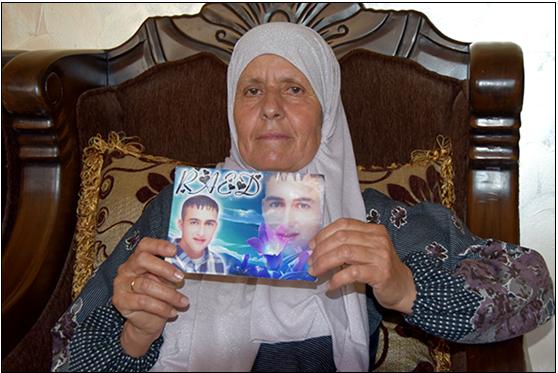
Na’ama Handi with photo of her son Raed whom she has not seen since the end of 2017

Na’ama Handi with photo of her son Raed whom she has not seen since the end of 2017 (Photo: B’Tselem)

Residents of the occupied West Bank who wish to visit their loved ones have to overcome bureaucratic hurdles in order to secure permission from the relevant authorities – the Civil Administration, the IPS and the Israel Security Agency (“Shin Bet”). After permission is received, the visits themselves entail a long day of traveling due to countless inspections and protracted delays.

First, the residents must apply for a permit to enter Israel through the office of the International Committee of the Red Cross, which has been responsible for coordinating between the visitors, the Civil Administration and the IPS since 1969. The Civil Administration issues permits to enter Israel for a prison visitation if the visitors are first-degree relatives – fathers, mothers, grandparents, spouses, children or siblings. The permits are usually valid for a year. Other relatives are only permitted to visit prisoners in exceptional cases, when the Israeli authorities acknowledge “humanitarian grounds” for the visit.

However, the Civil Administration limits first-degree relatives, too. If the Shin Bet classifies an applicant as denied entry to Israel “on security grounds,” he or she can only receive a “prison visitation permit for denied persons” – a special permit usually valid for 45 days and for a single visit – or none at all. In addition, all men between the ages of 16 and 35 are automatically denied an annual visit permit. Some are given a special single-visit permit. In practice, even relatives who receive an annual permit are not allowed to visit on a regular basis.

The IPS allows the families of Palestinian prisoners (political and criminal alike) incarcerated in Israel only one visit a month. Although regulations state that criminal prisoners are entitled to meet relatives under less stringent conditions than “security prisoners,” Palestinian visitors from the West Bank (excluding East Jerusalem) are only permitted to come with transportation organized by the Red Cross on prescheduled dates, and all visits are held under the strict conditions that apply to political prisoners.

The journey takes an entire day. All visitors, regardless of their age or health, must come to arranged meeting points early in the morning. They are then taken in buses hired by the Red Cross to the final checkpoint before entering Israel, where they undergo a security inspection that entails a lengthy delay, as Palestinian workers employed in Israel or in settlements in the “seam zone” also cross at those hours. The visitors then board new buses with Israeli license plates, also hired by the Red Cross. From the moment the buses leave the checkpoint; the security forces forbid opening the doors until arrival at the incarceration facility, even though the journey may take several hours. At the facility, the visitors undergo another security inspection, including a body search.

After undergoing this entire ordeal, the relatives get to see their loved ones behind a transparent partition and talk to them through a telephone receiver for 45 minutes. Prisoners are allowed to request a private meeting without a partition, but the prison authorities very rarely approve such requests.

According to B’Tselem: “With one exception, all the prisons in which Israel holds Palestinians are located within its sovereign territory and not in the Occupied Territories. Holding residents of the Occupied Territories within Israel violates international humanitarian law, which prohibits the transfer of civilians – including detainees and prisoners – from the occupied area to the territory of the occupying power. This ongoing breach of the law gravely violates the rights of Palestinians from the Occupied Territories to visit their relatives in prison with adequate frequency and under reasonable conditions. In many cases, they are denied the right to visit them altogether. The hardship entailed in visiting relatives imprisoned in Israel is just one example of the exhausting routine of occupation that Palestinians face daily.”

Full report by B’Tselem: https://www.btselem.org/detainees_and_prisoners/20180809_prisoners_visits




Data

Title: Israel Mistreats Relatives of Thousands of Palestinians Held Illegally in Its Territory
Link: http://maki.org.il/en/?p=16291
Source: Communist Party of Israel
Organization: CPI
Date: October 08, 2018 at 06:00AM

Actions

Translate original to: En | Es | Fr | De | Pt | Gr | Ca | +
Share original with: Twitter | Facebook | Google +

Labels: , ,

More information


Sunday, 7 October 2018


Concerned tenants in Haifa are protesting local urban renewal plans threatening the rights of some of the most vulnerable public housing residents. In the urban renewal process known as “vacate and build” (pinui/binui), residents stay in temporary housing while their old homes are demolished and replaced with modern facilities which the residents then return to. This is a common plan seen in numerous neighborhoods throughout Israel.

Demonstration by public housing residents during a speech by the Minister of Treasury, Moshe Kahlon, in Holon, September 5, 2018

Demonstration by public housing residents during a speech by the Minister of Treasury, Moshe Kahlon, in Holon, September 5, 2018 (Photo: Forum for Public Housing)

Just last month, during the most recent Knesset Public Housing Day, a group of tenants from Haifa’s Neve David neighborhood, slated to undergo the process, raised fears they would not be able to return to their apartments following the rebuilding due to increased maintenance fees.

Only now, a few weeks before the planned demolitions will begin, has the contract been revealed to the public. Alarmingly it shows that all the new apartments will be 83 square meters large. This means that the tenants will not be protected by a clause in the law designed to protect residents from increased maintenance rates upon return to the homes, as only homes up to 75 square meters qualify for this stipulation. If 83 square meters is the minimum apartment size possible, then the law must be amended to reflect this reality in order to protect the rights of vulnerable public housing residents.

Desperate from their fears of losing their homes and the networks of support they have built in their communities, the tenants – mostly elderly and immigrants – demonstrated at the site of the new project.

According to Bimkom – Planners for Planning Rights, an Israeli human rights organization formed in 1999 by a group of professional planners and architects, urban renewal in Israel is practically synonymous with urban densification. However very few of the urban densification projects initiated by the far-right government ever come to fruition because they are so fundamentally flawed. The government continues to invest in drafting these proposals, which are ineffectual, all the while the demand for housing continues to grow and prices continue to rise. “Socially-economically weaker communities are pushed out to peripheral urban areas, worsening the profound decline in already weakened urban centers of the country.”

Bimkom has conducted a comprehensive research report into various urban renewal strategies in Israel and abroad, including recommendations for workable, equitable solutions.

Related: Download the report by Bimkom (6 pages, in English)


Data

Title: Residents of Haifa Threatened with Eviction by Urban Renewal Plan
Link: http://maki.org.il/en/?p=16253
Source: Communist Party of Israel
Organization: CPI
Date: October 07, 2018 at 06:00AM

Actions

Translate original to: En | Es | Fr | De | Pt | Gr | Ca | +
Share original with: Twitter | Facebook | Google +

Labels: , ,

More information


More articles


Follow

Share

Tw
Fb
G+